
Pause/d
mapping my grief through poetry and pixels // field note 002

Lately, I have been reflecting on my “artistic journey” with The Science of Storytelling by Will Storr and The Creative Act by Rick Rubin as my companions. I recently finished Lidia Yuknavitch’s The Misfit’s Manifesto - Yuknavitch, who also wrote The Chronology of Water, a book that understands the fluid, non-linear nature of memory.
To be transparent, I’ve chosen these titles deliberately; non-fiction and sharp exposition are not my natural habitat. My relationship with words—how I dance and prance among the semantics and syntax of meaning—is a flowing choreography. I am, first and foremost, a poet.
How I became a poet was more incidental than intentional. How I became a writer professionally was even more unlikely. Paradoxically, the first half of my career was spent as a journalist.
Coming of age at the dawn of social networking, I spent my adolescence constantly online—poring over Multiply and eventually migrating to Tumblr. Some of those early writings survive in the crevices of the web. Back then, blogging was memory-keeping, not a vocation. I feared losing my memories because I was too fond of them. To create “immortal” copies—as stories—was my way of conquering time.
Beyond a mere recounting of days, memory-keeping is a tool of survival. Stories carry “social information”—relational dynamics and societal hierarchies. According to the theory of Robin Dunbar et al. in Human Evolutionary Psychology, language evolved primarily to trade this information. Instinctively, humankind has anchored its persistence on storytelling.
Writing tethered me to reality. I struggle with longer forms of writing but found my voice through metaphors. I learned to assert truth without compromising integrity. When multiple sensory inputs tilt to threshold, pinning them down with my pen sobers. I build a refuge against my own rage.
Grief is a wildfire. It leaps beyond pages.
Fast forward to my early 20s adulthood. For the first half of my career, I was geared to run with the fast-paced world of broadcast journalism in the metropolis. Decent Philippine media practitioners are poster children for crisis management. Ranking in the lower 110s out of 180 in the World Press Freedom Index [1], the information landscape is a dangerous (read: deadly) battleground for journalists. Factor in environmental and manmade disasters with a machinery of disinformation, one evolves to rapid-fire response with composure.
The buzz of rushing between deployments is addicting. Multi-awarded, numb, high, but lost in the wire with an inability to be still.
Then, the COVID-19 pandemic fractured the timeline.
In the Philippines, this wasn’t just a health crisis; it was a totalizing stasis. We endured what would become the longest and most militarized stay-at-home order globally. Movement was stripped back to the barest essentials, governed by quarantine passes, mandatory face shields, and checkpoints that turned a simple trip for groceries into a navigation of state authority.
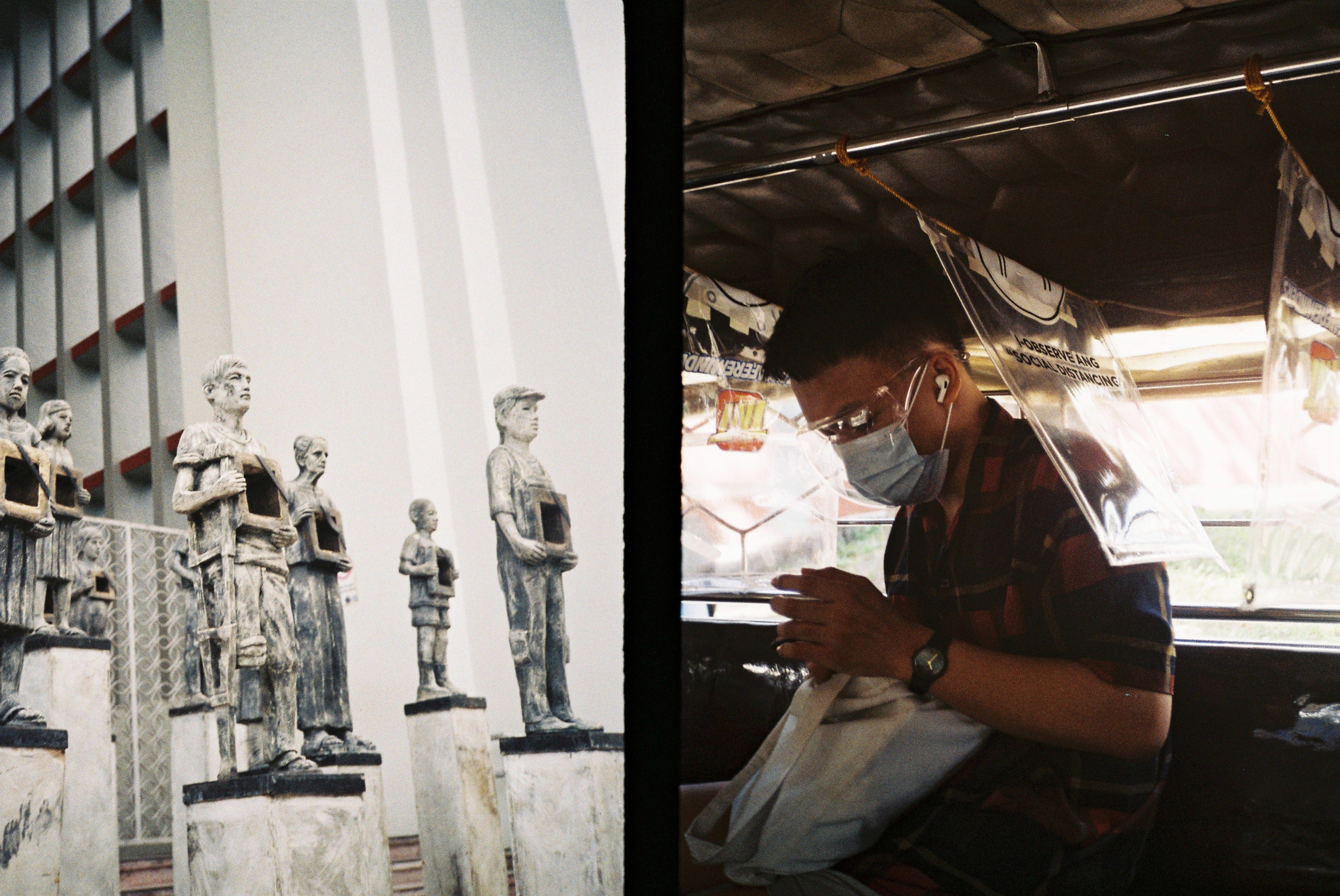
We were expected to adapt to a “new normal.” But when you are confined within four walls for months that bleed into years, the "facts" of the outside world, the absurdity of the mounting statistics, reach you only through sirens and screens. They don't help you breathe.
Isolation became alienation due to my own health struggles: a March 2020 emergency appendectomy rendering me bed-ridden, a 2021 Delta-variant infection necessitated admission to a quarantine facility, and a 2022 bout of dengue fever left me hospitalized. From supposedly roaring twenties, I was caught in the whiplash of a life seemingly stolen from me.
There is a specific kind of internal friction that occurs when reality becomes unrecognizable.
In a world that felt increasingly digital, sterile, and disposable, I retreated into the mechanical and the tactile. I picked up my half-frame Canon Demi EE28 and acquired a Nikon FM—not to "cover" the news, but to capture the high-grain reality of a life that felt like it was slipping through my fingers. I began to practice the "art of noticing" as a form of quiet resistance.
I began to document the visual fragments of this suspended existence—the clockwork of cities under curfew, and eventually, the saltwater grace of the ridges and the reefs. I wasn’t just taking photos or writing poems; I was anchoring myself to the earth so I wouldn't drift away in the static.
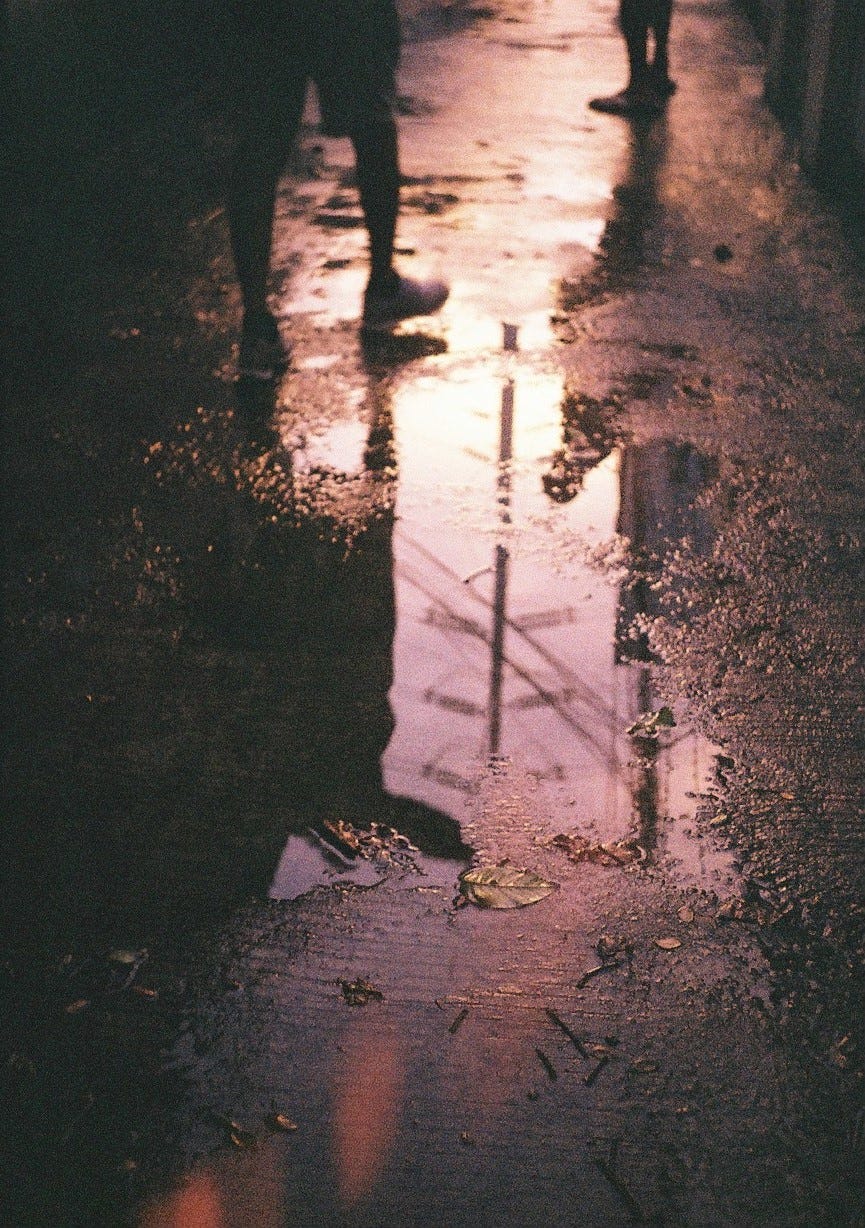
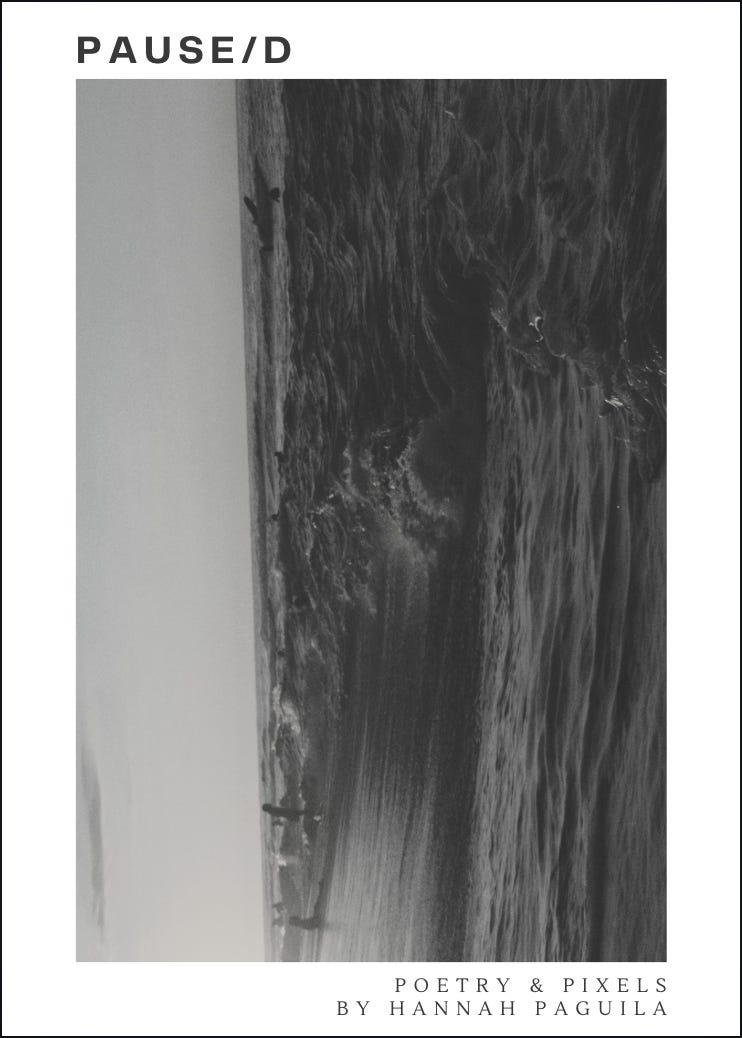
This is the origin of PAUSE/D, my collection of poetry and pixels. Initially, it was intended as a chronological archive of those years of suspension. Perhaps the main lesson was to surrender. The release came with releasing — timelines, control, roles we have outgrown.
Now I'm 31. Writing has helped make peace with my mourning. Apart from documentation, PAUSE/D is a gesture of honoring the liminal and of seasons changing. I share these pages as an offering, a respite. Unfold the pages, find what resonates, and allow yourself to move with the current of your own remembering.
Thank you for sharing your journey. It was the pandemic that also ushered me into writing again (my first love).